Mammal Diversity Database (MDD) — Web Map & API
Overview
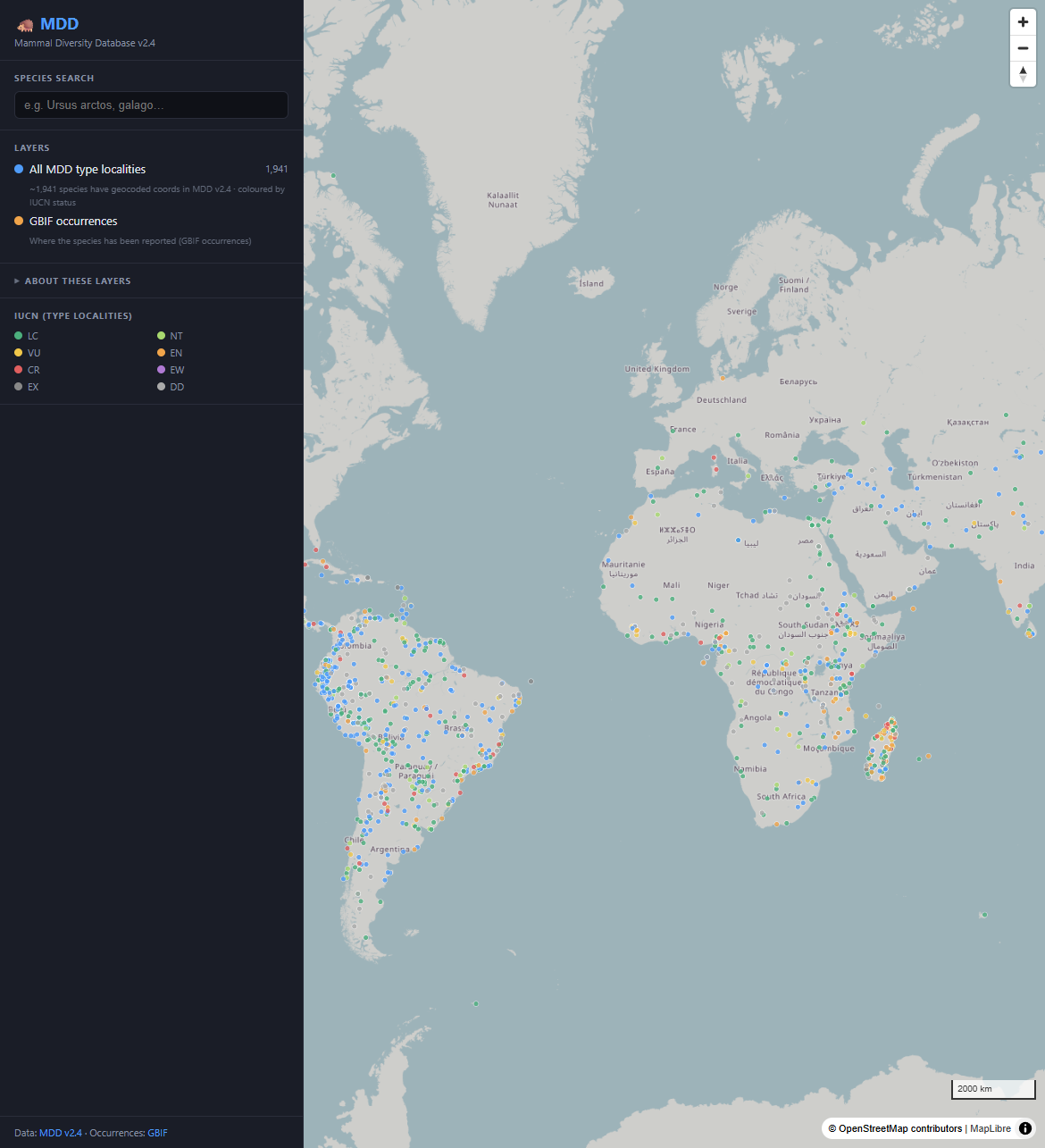
An interactive web map and REST API built on the Mammal Diversity Database v2.4 — 6,871 mammal species with nomenclatural synonyms, type localities, and optional GBIF occurrence overlays. DuckDB is the analysis backbone; a React + MapLibre frontend and FastAPI backend are packaged in a single Docker image for deployment.
Data: MDD v2.4 (Zenodo) + GBIF Occurrence API
Role: Solo project
Status: Active — live on Render
Live demo: mdd-map.onrender.com
Repository: github.com/ulfboge/MDD
What it does
| Component | Description |
|---|---|
| Taxonomy DB | DuckDB built from five MDD CSV files — species, ~100k synonyms, type specimen metadata, version diff |
| Harmonization | Resolve any reported name (GBIF, field CSV, literature) to the current MDD accepted name via the synonyms table |
| Type localities | ~1,941 geocoded holotype collection sites, coloured by IUCN status on the map |
| GBIF pipeline | gbif_import.py fetches occurrences, harmonizes names, and stores them in DuckDB + GeoParquet |
| Web map | Species / genus / family search, museum & country coverage filters, CSV export for missing coordinates, IUCN popups |
| API | FastAPI — species lookup, type-localities GeoJSON, occurrences per species, health check |
| Deploy | Single-container Docker (nginx + uvicorn + baked DuckDB); render.yaml for Render |
Methods & Tools
| Layer | Technology |
|---|---|
| Database | DuckDB (spatial extension, GeoParquet export) |
| Backend | Python 3.11, FastAPI, uvicorn |
| Frontend | React, TypeScript, Vite, MapLibre GL JS |
| Data ingest | SQL scripts + setup_database.py, gbif_import.py, harmonize_names.py |
| GIS export | GeoParquet for QGIS; PostgreSQL/PostGIS migration scripts |
| Container | Docker, nginx reverse proxy |
| Hosting | Render Blueprint (render.yaml) |
Design principle: MDD is the taxonomy backbone — external datasets (GBIF, IUCN, field CSVs) are harmonized to MDD via species_id and the synonyms table, not the other way around. Coordinates in MDD are type specimen localities (where the holotype was collected), not species range centroids.
Key features
- Global map of ~1,941 geocoded type localities with IUCN colour symbology
- Species autocomplete across 6,871 accepted names
- Per-species type locality highlight and optional “show all” layer
- GBIF occurrence layer (populated locally via import pipeline; not at container startup on free tier)
- Reproducible build:
setup_database.pyregenerates the full DuckDB from raw CSVs - QGIS-ready GeoParquet exports and documented PostGIS migration path
Links
Live Demo View Code on GitHub MDD data source
Citation
Mammal Diversity Database. (2026). Mammal Diversity Database (Version 2.4) [Data set].
Zenodo. https://doi.org/10.5281/zenodo.18135819